
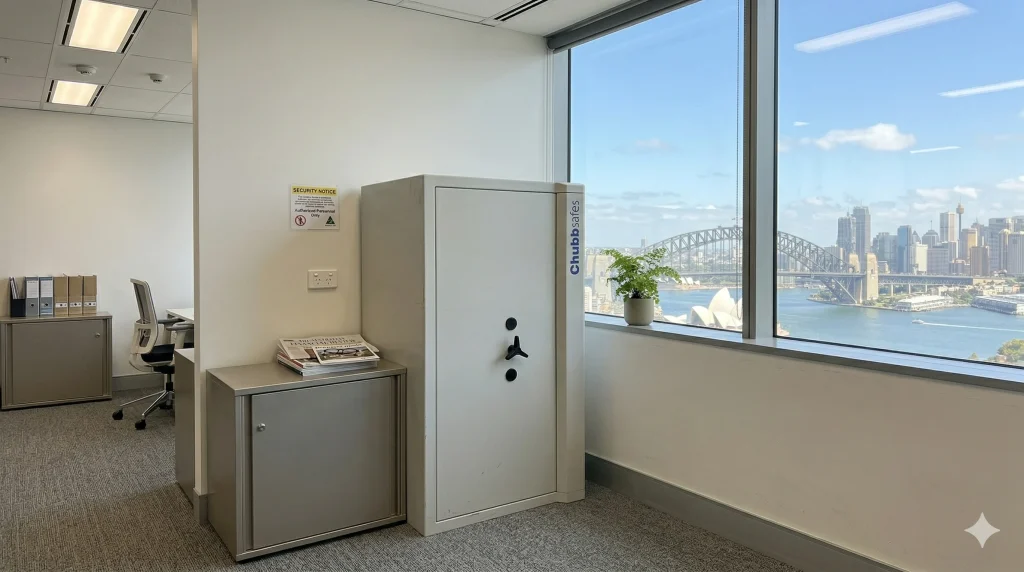
Every business, whether a corner café or a mid-size law firm, faces the same core risk: valuable assets — cash, documents, digital media, firearms, pharmaceuticals — can be lost to theft, fire, or disaster in minutes. A well-chosen commercial safe is one of the most cost-effective risk management tools available. Yet many businesses either under-invest in security or buy the wrong type entirely.
This guide breaks down every major commercial safe category, explains the ratings system that actually matters, and gives you a practical framework for making the right choice.
Why commercial safes differ from residential ones
Commercial safes are not simply bigger home safes. They are engineered to different threat profiles. A business faces higher-frequency access requirements, a greater chance of internal theft, and often stricter regulatory or insurance mandates. Key differences include:
- Higher fire ratings — often 60–120 minutes vs 30 minutes for residential
- Multi-user access controls (audit trails, time locks)
- Anti-internal-theft features like deposit slots with one-way access
- Heavier construction — TL-rated resistance to power tools
- Industry-specific certifications (banking, pharmacy, hospitality)
The six main types of commercial safes
Cash management
Deposit / drop safes
One-way deposit slot lets staff drop cash without accessing the main compartment — the primary anti-internal-theft design. Common in retail, restaurants, and hospitality.
Fire protection
Fire-resistant office safes
Insulated walls and door keep interior temperature below the combustion point of paper (around 451°F) for a rated time window. Essential for document-heavy businesses.
Maximum security
High-security / TL-rated safes
UL-certified to resist power tools for 15–30+ minutes. Used in jewellery stores, banks, pharmacies. The gold standard for burglary resistance. Often 500–1,000+ kg.
Digital assets
Data / media safes
Maintain interior below 125°F (the damage threshold for magnetic media) and protect against humidity. Required for businesses with physical backup drives, tapes, or film.
Smart safes
Smart / connected safes
Integrate cash management software with real-time tracking, counterfeit detection, and direct bank account linking. Increasingly common in large retail and banking environments.
Vaults
Walk-in vaults
Not portable — entire rooms built with reinforced steel doors and complex multi-lock systems. Used by banks, high-value retailers, and government facilities. Fire-proof as standard.
Understanding UL ratings — the standard that matters
Underwriters Laboratories (UL) is the primary independent certification body in North America. Insurance companies and commercial tenants increasingly require UL-rated safes. Here’s what the common ratings actually mean:
| Rating | What it means | Typical use | Security level |
|---|---|---|---|
| B / C rating | No burglar testing — only means a lock is present. Door and body steel minimums only. | Low-risk storage | Entry |
| UL RSC | Residential Security Container — resists a 5-minute attack with hand tools | Office documents | Basic |
| UL TL-15 | Tool-resistant for 15 minutes against power tools, carbide drills, and saws | Cash, jewellery | Medium |
| UL TL-30 | Tool-resistant for 30 minutes — significantly harder to breach than TL-15 | Banks, pharmacies | High |
| UL TL-30×6 | TL-30 protection on all six sides of the safe, not just the door | Jewellers, vaults | Very high |
| UL TRTL-30×6 | Torch AND tool resistant for 30 min on all six sides — top commercial grade | High-value storage | Maximum |
Insurance tip: Many commercial insurers require a minimum UL TL-15 rating to cover contents above a certain value threshold. Always check your policy before purchasing — the safe rating can directly affect your premium and your maximum insured value.
Fire ratings explained
Fire ratings for commercial safes are expressed as time at temperature — for example, “120 minutes at 1,850°F.” The number tells you how long the internal temperature stays below the damage threshold for your contents:
- Paper: combusts at around 451°F (233°C) — any UL 350 rated safe protects this
- Magnetic media / hard drives: damaged above 125°F (52°C) — requires a specialised media safe
- Film / USB / optical media: damaged above 125°F — same requirement as magnetic media
The UL 350/1-Hour and UL 350/2-Hour ratings are the most trusted benchmarks. A commercial building fire can reach 1,000°F in under four minutes, so anything below a 60-minute rating is considered marginal for most business environments.
Lock types for commercial safes
The lock is your first line of defence and your most-used component. Commercial environments generally favour:
Electronic / digital keypad
The most common choice for businesses. Codes can be reprogrammed as staff change, access can be logged, and many models offer a manager override code. Requires battery maintenance.
Biometric (fingerprint / iris)
Fastest access with the strongest identity binding. Ideal where only specific named individuals should have access — no code-sharing possible. More expensive and requires regular firmware updates.
Mechanical combination
No batteries, no electronics to fail. Still used in high-security bank vaults because there’s nothing to hack or power-cycle. Slower to open; changing the combination requires a locksmith.
Time-delay locks
Mandatory in many banking and high-risk retail environments. Even with the correct code, the safe won’t open for a programmed delay (often 5–10 minutes). Dramatically reduces robbery incentive since attackers can’t force a quick opening.
Installation best practices
- Bolt to the floor or wall — even a 300 kg safe can be removed with a utility dolly and two people if unanchored
- Place in a low-visibility area, but one you’ll actually use — a hard-to-reach safe gets ignored
- Install a monitored alarm — a triggered alarm limits a burglar to under 10 minutes on-site
- Restrict knowledge of the safe location to essential staff only
- Change access codes immediately after any staff departure
- Service the locking mechanism annually — a seized bolt costs far more in locksmith fees than prevention
- Keep a record of the serial number and safe model in an off-site location for insurance claims
Choosing the right safe for your business type
| Business type | Primary risk | Recommended type | Minimum rating |
|---|---|---|---|
| Retail / café | Internal theft, cash | Deposit safe | B-rated minimum |
| Law / accounting firm | Document loss | Fire-resistant office safe | UL 350/1-Hour |
| Jeweller | Burglary | TL-30×6 high-security | UL TL-30×6 |
| Pharmacy | Controlled substances | TL-rated + time lock | UL TL-30 |
| Bank branch | Robbery + fire | Walk-in vault or TL-30×6 | TRTL-30×6 |
| Medical records | Fire + data | Media safe or fire composite | UL 125/1-Hour |
Key takeaways
Commercial safes are purpose-built tools, not generic boxes. Match the safe type to your specific threat — a deposit safe won’t protect your documents in a fire, and a fire-resistant safe won’t stop a determined burglar with a grinder. Invest in a UL-rated product, anchor it properly, pair it with a monitored alarm, and review your setup whenever your business changes significantly. The right safe isn’t an expense — it’s insurance you only pay for once.