
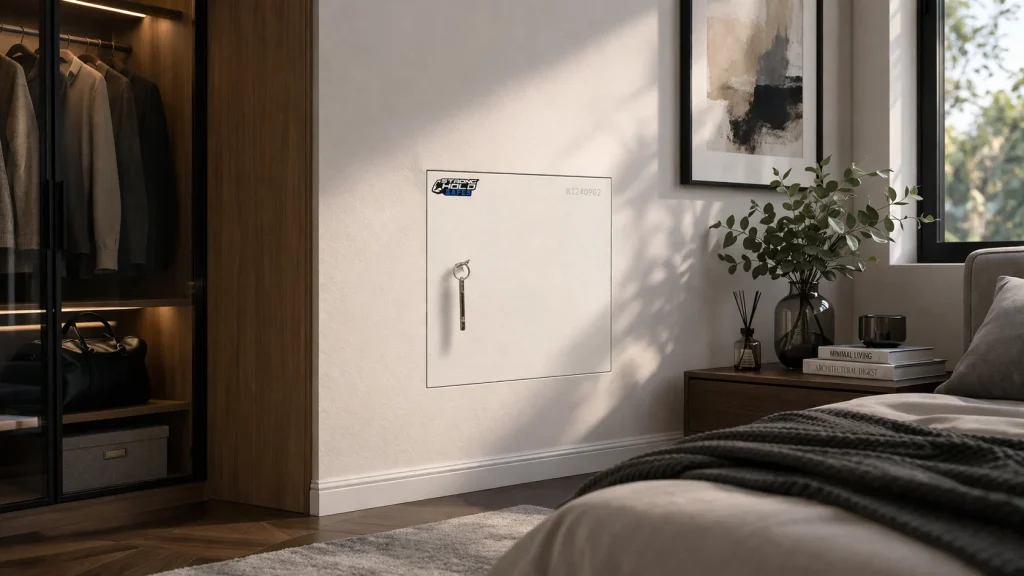
Most people buy a home safe after something goes wrong — a break-in, a near-miss flood, or a house fire that destroys irreplaceable documents. The better time to buy is before any of that happens. A correctly chosen safe costs less than a single insurance claim excess and protects things — passports, birth certificates, irreplaceable photos, heirlooms — that money can’t replace.
This guide covers every residential safe type, the ratings that actually matter, how to pick the right size, and where and how to install it so it actually does its job.
What are you protecting? Start here.
The biggest mistake homeowners make is buying a safe without first defining what goes in it. Your contents dictate the type of safe you need — and different items have very different protection requirements:
| Item type | Key threat | Temperature sensitivity | Safe type needed |
|---|---|---|---|
| Paper documents (birth cert, will, title deeds) | Fire, flood | Combusts above 451°F | Fire-resistant safe (UL 350) |
| Cash, jewellery, coins | Theft | Low | Burglary-resistant or TL-rated |
| Hard drives, USB, optical media | Fire, humidity | Damaged above 125°F | Media/data safe (UL 125) |
| Firearms, ammunition | Unauthorised access, theft | Moderate | Gun safe (UL RSC or higher) |
| Jewellery (delicate items) | Theft, scratching | Low | Felt-lined jewellery safe |
| Passports, credit cards | Theft, fire | Combusts above 451°F | Compact fire + burglary safe |
Important: A fire-resistant safe is not the same as a fire-proof safe. No consumer safe is truly fireproof — all ratings reflect a time limit. A UL 350/1-Hour safe keeps the interior below 350°F for one hour, not indefinitely. Plan for the fire department response time in your area.
The four main types of home safes
🔥
Fire-resistant safes
Constructed with gypsum board or ceramic wool insulation between steel plates. Rated for 30–120 minutes. Best for paper documents and family records. Not all offer meaningful burglary resistance — check for both ratings if needed.
🔐
Burglary-resistant safes
Heavier steel construction, pry-resistant doors, and reinforced hinges. UL-rated from RSC (basic hand-tool resistance) up to TL-30. Best for cash, jewellery, and high-value items. Can be freestanding, floor-mounted, or in-wall.
💎
Jewellery safes
Steel outer construction with soft felt-lined interior to protect delicate items from scratches. Multiple drawers and compartments for organisation. Usually a combination of moderate burglary and fire resistance.
🔫
Gun safes
Specifically designed for firearms — lockable access, adjustable interior shelving, and often fire-rated. Door thickness is critical: look for at least ¼” solid plate steel. UL RSC is the minimum useful burglary rating. Many include a dehumidifier rod to prevent corrosion.
Placement options compared
Freestanding floor safe
The most common type. Can be heavy enough to deter casual theft on its own, but should always be bolted to the floor regardless. Accessible and practical. Works in any room. Watch your floor’s load capacity for very large models (500+ kg).
Advantages
- Wide range of sizes available
- Easy to anchor to floor
- Most fire-rated models in this category
- Can be concealed behind furniture
Limitations
- Visible if room is searched
- Can be removed if not anchored
- Heavy models need structural floor support
In-wall safe
Recessed between wall studs. Very concealable behind artwork or mirrors. Serious limitation: wall cavity depth is limited by stud spacing (typically under 4″ in standard construction), so capacity is small. Also vulnerable to saw-out attacks if not properly reinforced. Best for items you access often but need hidden, like prescription medications or small amounts of cash.
Advantages
- Highly concealable
- Convenient for frequent access
- Space-saving
Limitations
- Very limited depth (under 4″)
- Vulnerable to wall saw-out
- Minimal fire protection in most models
Floor (embedded) safe
Set into the concrete floor during construction or renovation. Extremely difficult to remove. Limited by floor access — usually only suitable for single-floor homes or basements. Near-invisible when covered with flooring or a rug. Low capacity in most models.
Advantages
- Impossible to remove without major demolition
- Completely concealable
- Good for long-term document storage
Limitations
- Difficult and expensive to install
- Vulnerable to flooding (low position)
- Low capacity
Understanding residential ratings
Burglary ratings (UL)
Look for these in order of increasing security: B/C rating (no testing, just a lock — avoid for anything valuable), UL RSC (resists a 5-minute hand-tool attack — the minimum worth buying), UL TL-15 (power-tool resistance for 15 minutes), UL TL-30 (30 minutes — overkill for most homes but worth it for high-value collections).
Warning: Home safes without at least a UL RSC rating can be opened in under five minutes with a common hammer and screwdriver. If you’re storing anything genuinely valuable, the RSC is a minimum — not a luxury.
Fire ratings (UL 72)
The UL 350 standard is what you want for paper documents — it means the internal temperature stays below 350°F. For digital media, you need the stricter UL 125 standard, which keeps the interior below 125°F. Common durations are 30 minutes, 60 minutes, and 120 minutes. A 1-hour rating is the practical minimum for most residential settings given average fire department response times.
Water resistance
Separate from fire ratings. Relevant if you live in a flood zone or a humid climate. Look for a UL 72 water seal rating, which means the safe was submerged for 8 hours and contents remained dry. Fire door seals that expand when heated also help exclude water during fire-fighting sprinkler activation.
Lock type comparison
| Lock type | Best for | Pros | Cons |
|---|---|---|---|
| Key lock | Infrequent access, simple storage | No batteries, low cost, reliable | Lost key = compromised security; keys can be copied |
| Dial combination | Long-term document storage | No batteries, very durable, no code to steal electronically | Slow to open; hard for people with poor dexterity; locksmith needed to change |
| Electronic keypad | Regular daily access | Fast, reprogrammable, some models log access attempts | Requires batteries; risk of lockout if batteries die unexpectedly |
| Biometric | Quick access, single user or small family | Fastest access, no code to forget or share, high identity assurance | Higher cost, battery-dependent, occasional false rejections |
Sizing your safe: a practical approach
Exterior dimensions are misleading — wall thickness eats into usable interior space significantly. Always check the interior cubic footage. A rough guide:
- Under 0.5 cu ft: documents, a few items of jewellery, passports
- 0.5–1.5 cu ft: documents, jewellery, a small amount of cash, one or two handguns
- 1.5–3 cu ft: full document collection, jewellery, electronics, multiple firearms
- 3+ cu ft: long guns, large collections, business backup storage
Industry advice: buy at least one size larger than you think you need. Safes fill up faster than expected, especially as you add important documents over time.
Where to place your home safe
- Avoid the bedroom — it’s the first place burglars search. A master bedroom safe is the most commonly targeted location.
- Choose a room you actually use — if the safe is inconvenient to reach, you won’t use it consistently, defeating its purpose.
- Ensure adequate lighting — you need to see the keypad or dial to use it quickly and reliably.
- Check floor load capacity — for safes over 200 kg, verify the floor structure can support the weight, especially on upper floors.
- Conceal the safe — a bookcase, cabinet, or piece of furniture positioned in front significantly increases deterrence without reducing accessibility.
- Anchor it — use the pre-drilled anchor holes present on virtually all modern home safes. A 150 kg unanchored safe can be moved with two people and a trolley.
The “safe within a safe” strategy for digital media
Most homeowners can’t justify the cost of a dedicated UL 125 media safe. A practical alternative: place a small portable media-rated safe inside a larger fire/burglary safe. The outer safe provides burglary resistance and structural fire insulation; the inner safe provides the precise temperature control needed for digital media. This approach provides excellent protection at a fraction of the cost of a purpose-built media vault.
Budget tiers: what to expect at each price point
| Price range (AUD) | What you get | Suitable for |
|---|---|---|
| $100–$300 | Basic steel, digital lock, minimal fire rating. No independent testing. B/C rating equivalent. | Opportunistic deterrence only — keeps casual intruders out |
| $300–$800 | UL RSC or equivalent, 30–60 min fire rating, electronic or biometric lock. Entry-level independent testing. | Documents, jewellery, everyday valuables |
| $800–$2,500 | UL TL-15 or TL-30, 60–120 min fire rating, dual-locking bolts, heavy steel. Independently certified. | High-value collections, firearms, significant cash |
| $2,500+ | TL-30×6 rated, composite construction, biometric + electronic dual-lock, full fire and water protection. | Serious collectors, home offices, high-net-worth households |
Maintenance checklist
- Replace electronic lock batteries every 12 months — don’t wait for the low-battery warning during an emergency
- Lubricate locking bolts annually with a dry lubricant (not WD-40, which attracts dust)
- Check anchor bolts for corrosion every 2–3 years, especially in humid environments
- Update access codes after any home security event or change in household access
- Keep a record of the safe model, serial number, and combination/code in a secure off-site location (e.g. safety deposit box or secure cloud storage)
Key takeaway
The best home safe is the one that matches the specific threats facing your specific contents — not the biggest, not the cheapest, and not the one that’s simply convenient to buy. Define what you’re storing, check your fire department’s average response time, and use the UL ratings as your primary quality filter. A properly anchored, correctly rated safe paired with a home alarm system is a genuinely strong residential security solution.

