To bolt down a safe properly, fix it through its factory anchor holes into the most solid part of the building, usually a concrete slab, using anchors rated for that material and sized to the holes. On a slab, that means masonry expansion anchors or chemical (resin) anchors set to the correct depth. On a timber floor, it means fixing into the bearers or joists, ideally bolted right through with a backing plate underneath, and never just into the floorboards. Done well, anchoring turns a heavy steel box into a fixture that a burglar cannot simply wheel out the door.
Why an unbolted safe is the weak point
A safe is designed to resist attack on its door, lock and boltwork, on the assumption that it stays where it is. An unanchored safe changes the problem for a thief. Rather than working on the door on site, under time pressure and making noise, they can tip it onto a trolley, load it into a vehicle and open it somewhere quiet. A safe on its side or back also exposes faces that were never meant to take the brunt of an attack.
Weight alone is not much of a deterrent. Our HD Series home safes start at 68 kg (HD1), and the HD4 weighs 220 kg. That is heavy for one person, but two determined people with a sack truck can move far more. Australian firearm laws take the same view: most states require gun storage that weighs less than 150 kg empty to be fixed to the building. Tasmania’s Firearms Regulations 2016, for example, call for internal masonry fixings or coach screws, at least twice to a wall and twice to the floor, or four times to either. Those rules are written for firearms, but the principle applies to any safe: if it can be moved, it can be taken.
Anchoring can matter for insurance too. Some policies set conditions on how a safe is installed before its contents are covered, so read your policy wording and ask your insurer if you are unsure.
Bolting a safe to a concrete slab
A concrete slab on ground is the best base for a safe in most Australian homes and businesses. Every HD Series safe has four 16 mm recessed anchor holes in its base, and the DS Series drug safes, the SC1600 security cabinet and the RS10 rifle safe are each pre-drilled with four 16 mm anchor holes for floor mounting. The fixings go through the floor of the safe from the inside, so they cannot be reached while the door is closed.
Mechanical expansion anchors
Sleeve and wedge anchors grip by expanding against the sides of the drilled hole as they are tightened. They are quick to install and hold well in sound, fully cured concrete. Because they work by expansion, they need enough distance from the slab edge and enough slab thickness; in thin, old or cracked concrete, the expansion force can break out the surrounding material.
Chemical anchors
A chemical anchor uses an injected resin that bonds a threaded rod into the hole. It does not rely on expansion, so it suits older or softer concrete, positions closer to an edge or wall, and installations where maximum pull-out resistance is the goal. The trade-off is curing time. The resin must fully set before the nuts are tightened and the safe is loaded, and cure times vary with the product and the temperature.
What to check before drilling
- Services in the slab. Water pipes, in-slab heating and electrical conduits are common. A careful installer checks plans or scans the area first.
- Post-tensioned slabs. Many apartment buildings, and some houses, use slabs containing steel tendons under very high tension. Drilling into a tendon is dangerous and expensive to repair, so if there is any chance your slab is post-tensioned, have it scanned or check the structural drawings before anyone drills.
- Waterproofing. Avoid wet areas where drilling would breach a waterproof membrane.
- Slab thickness and condition. Anchors need enough embedment to hold. Very thin or deteriorated concrete may call for a different approach.
Bolting a safe to a timber floor
Suspended timber floors are common in Queenslanders, weatherboard homes and upper storeys. They can be anchored to, but floorboards on their own offer almost no resistance. A screw that only grips a 19 mm board can be levered out in seconds.
- Find the structure. Position the safe so its anchor holes line up with bearers or joists, or add solid timber blocking between the joists beneath it.
- Bolt through where you can. Through-bolts with large washers or a steel backing plate underneath are far harder to pull out than screws. Where there is no access below, heavy coach screws into the joists are the usual alternative.
- Add wall fixings. Combining floor fixings with fixings into studs or masonry adds resistance to levering and tipping.
- Think about load. A larger safe concentrates a lot of weight on a small footprint. On a suspended floor, have the structure checked before a heavy safe goes in.
Choosing the position
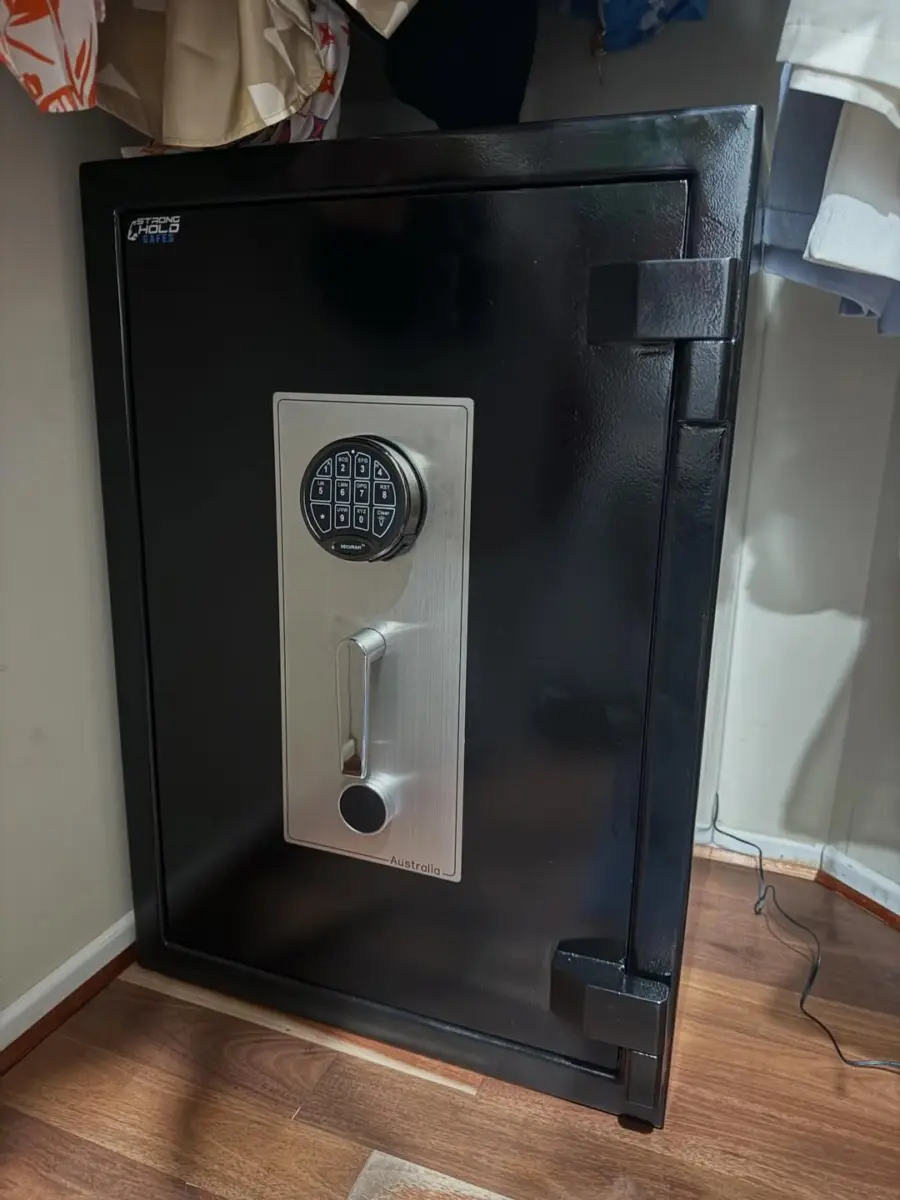
The best spot is solid, discreet and practical. A corner lets you fix to the floor and, if needed, two walls, and it limits the room an attacker has to swing tools. A robe or cupboard keeps the safe out of sight. Leave room for the door to open fully, and avoid detached garages and sheds where a thief could work unseen with power tools. If you are still weighing up a freestanding safe against an in-floor safe, remember the installation is completely different: an in-floor safe is set into the slab itself.
When to use a professional installer
Anchoring a small safe to a known, sound slab is within reach of a capable tradesperson. A professional safe installer is the better choice when:
- the safe is heavier than two people can safely handle, or has to go up stairs;
- the slab may be post-tensioned, or you cannot locate the services in it;
- the floor is suspended timber, or you do not know how it is built;
- your insurer or a regulator sets conditions on how the safe must be fixed;
- you want the safe levelled so the door swings and closes correctly.
Levelling matters more than most people expect. If the body twists as the anchors are tightened onto an uneven floor, the door can bind and the bolts can drag, which wears the lock. Installers shim the base before final tightening for exactly this reason. Stronghold provides professional delivery and installation Australia-wide, including bolt-down.
Key takeaways
- Use the safe’s own anchor holes and fix from inside the safe.
- On concrete, use masonry or chemical anchors sized to the holes and set to the right depth.
- On timber, fix into bearers or joists, preferably through-bolted with a backing plate.
- Check plans or scan before drilling a slab, especially in apartments.
- Level the safe before final tightening so the door and lock work freely.
- Check your insurance policy for any installation conditions.
Frequently asked questions
Can I bolt a safe to a wall instead of the floor?
Wall fixings help, especially combined with floor fixings, but plasterboard or a single stud will not hold a safe against a determined attack. Fix into solid masonry or framing, and treat the floor as the main anchor wherever possible.
Does a heavy safe still need bolting down?
In almost every case, yes. Weight slows a thief, but a sack truck or pallet jack makes light work of a few hundred kilograms. Anchoring removes the option of taking the safe away to open it.
Can I bolt down a safe in a rental or apartment?
Drilling usually needs the owner’s permission, and in a strata building the slab may be common property and may be post-tensioned. Get written approval and have the slab checked before any drilling.
Will Stronghold install the safe for me?
Yes. Through our national partner network, we deliver and professionally install Stronghold safes across Australia, including bolt-down installation.
If you would like advice on anchoring a safe in your home or business, speak with a Stronghold specialist or visit one of our showrooms in Victoria, Queensland, Western Australia or Tasmania. We will recommend the right model for your floor and arrange installation by people who do it every day.