Every Australian state and territory requires licensed firearm owners to keep firearms in a locked receptacle built to a set standard, to fix lighter receptacles to the building, and to store ammunition separately under lock. The details differ, from steel thickness to when alarms are required, and several states have changed their rules recently. This guide summarises what each regulator publishes as at October 2026, with links to the official sources. It is general information, not legal advice: confirm the current requirements with your firearms registry before you buy or install storage.
The common ground
Storage rules across Australia grew from the National Firearms Agreement, so the categories are broadly similar nationwide:
- Categories A and B cover most rifles and shotguns that are not self-loading or pump action.
- Categories C and D cover most self-loading and pump-action firearms, which are restricted to specific purposes.
- Category H covers handguns.
- Some states use extra categories, such as Category E in Queensland and Western Australia.
In general, Category C, D and H firearms face stricter construction rules, receptacles under 150 kg empty must be fixed to the building in most jurisdictions, and ammunition must be locked away separately.
State and territory requirements
Victoria
Victoria’s rules are in Schedule 4 of the Firearms Act 1996. Since 30 August 2022, all firearms, including Category A and B longarms, must be stored in a purpose-built receptacle made of steel at least 1.6 mm thick. A receptacle weighing less than 150 kg empty must be bolted to the structure of the premises and locked with a sturdy lock. Ammunition must be kept in a separate locked container, although a purpose-built unit with two separately lockable compartments is acceptable. See Victoria Police: Firearm storage.
New South Wales
Under the Firearms Act 1996, Category A and B firearms must be kept in a locked receptacle of an approved type, made of hard wood or steel and not easily penetrable, and a receptacle under 150 kg empty must be fixed to prevent its easy removal. Category C, D and H firearms must be kept in a locked steel safe of an approved type, bolted to the structure of the premises. Ammunition must be stored in a separate locked container. Under reforms being phased in, from 1 July 2026 a permit to acquire is only issued after a passed safe storage inspection at your nominated storage address. See NSW Police Firearms Registry: Safe storage.
Queensland
Under the Weapons Act 1990 and Weapons Regulation 2016, firearms must be stored unloaded in a locked container with a sturdy combination lock, keyed lock or keyed padlock, kept locked except while a weapon is put in or taken out, and ammunition must be stored separately. A significant change is coming: from 12 March 2027, containers for Category A, B, C, E and M weapons must be solid steel, and fixed to the frame or floor of the building if they weigh less than 150 kg. Solid timber containers will no longer be permitted. See Queensland Police: Safe storage of weapons and ammunition.
Western Australia
The Firearms Act 2024 and Firearms Regulations 2024 commenced on 31 March 2025 and introduced tiered storage. Your level depends on how many firearms you hold (1 to 5, 6 to 15, or 16 or more), whether the storage place is occupied, and the highest category stored. According to WA Police’s storage and security information sheet, Level 1 is a 3 mm steel cabinet with a 6 mm steel door; Level 2 is a 6 mm steel cabinet with a 10 mm door; and a Grade V safe or a compliant secure room or strongroom is accepted at every level. Some situations also require an alarm and CCTV. Existing approved storage can generally continue until you add or replace a firearm. Ammunition must still be stored separately. See WA Government: Firearms.
South Australia
Standards are set by the code of practice in Schedule 1 of the Firearms Regulations 2017, made under the Firearms Act 2015. The minimum storage depends on the number and category of firearms held. SA Police guidance describes safe levels by steel thickness, with a Level 1 safe of structural grade mild steel at least 2 mm thick and a Level 2 safe at least 3 mm thick, and requires safes under 150 kg empty to be bolted to a solid floor, wall or structure with at least two anchor bolts. See SA Police: Firearms storage and security.
Tasmania
The Firearms Regulations 2016 require a locked receptacle that is not easily penetrable, with an internal lock and internal hinges or an equivalent anti-removal mechanism. Steel must be at least 2 mm thick for Category A and B and 3 mm for Category C, D and H, or the receptacle may be concrete. A receptacle under 150 kg empty must be fixed with internal masonry fixings or coach screws, at least twice to a wall and twice to the floor, or four times to either. Ammunition needs its own locked receptacle or compartment that is not opened by the same key. Premises storing a Category H firearm, or 10 or more firearms, need an alarm or visual recording device. See Tasmania Police Firearms Services.
Australian Capital Territory
ACT Policing guidance says up to 10 Category A or B firearms may be kept in a lockable metal container, with firing mechanisms in a separate lockable compartment, or a hardwood container lined with steel sheeting, bolted down with at least two anchor bolts unless it weighs 150 kg or more empty. More than 10 firearms, or any Category C, D or H firearm, requires a metal, concrete or brick safe. See ACT Policing: Firearms storage.
Northern Territory
NT Police recommend steel of 3 mm or more for Category A and B cabinets and do not accept steel under 2 mm, with at least two bolt-down points (four recommended) and two internal locking points; a cabinet over 150 kg empty need not be bolted. Category C, D and H safes need a door at least 6 mm thick and a body at least 3 mm, safe-quality locks, and fixing to a wall or floor. NT Police guidance requires ammunition to be stored separately in a locked container. See NT Police: Storage requirements.
Choosing a safe that meets your state’s rules
Start with your licence category, number of firearms and storage location, then confirm the requirement with your registry. When comparing gun safes, ask for the body and door steel thickness, locking points, hinge design, empty weight and anchor points.
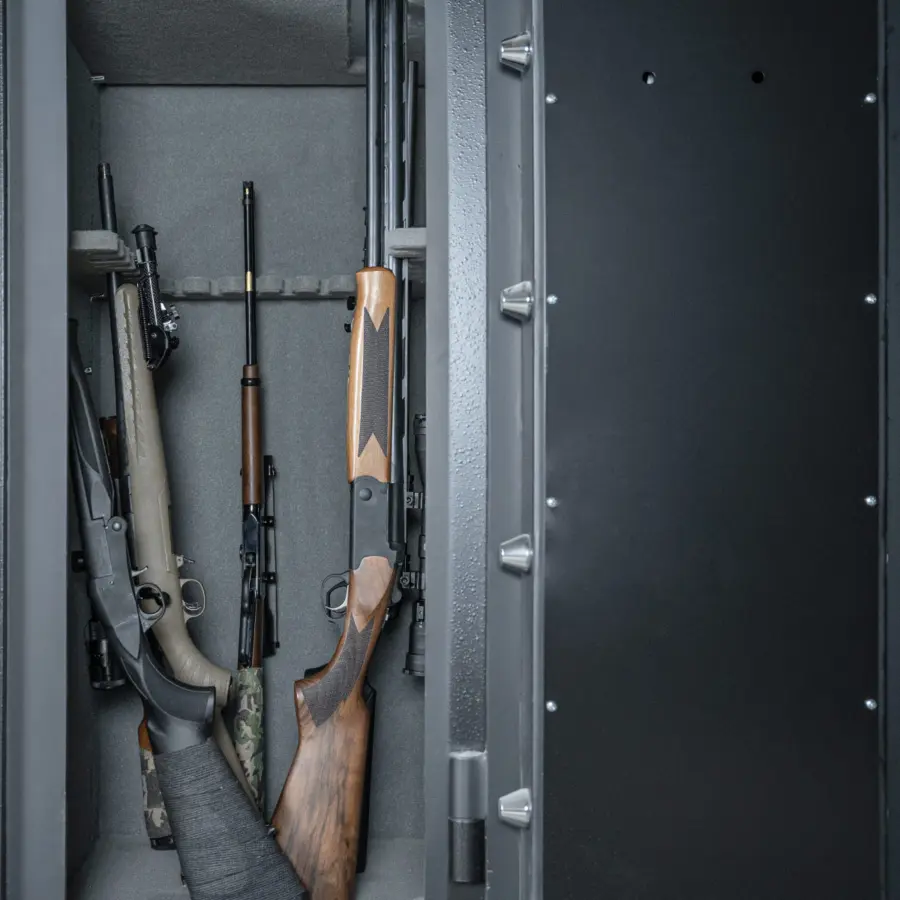
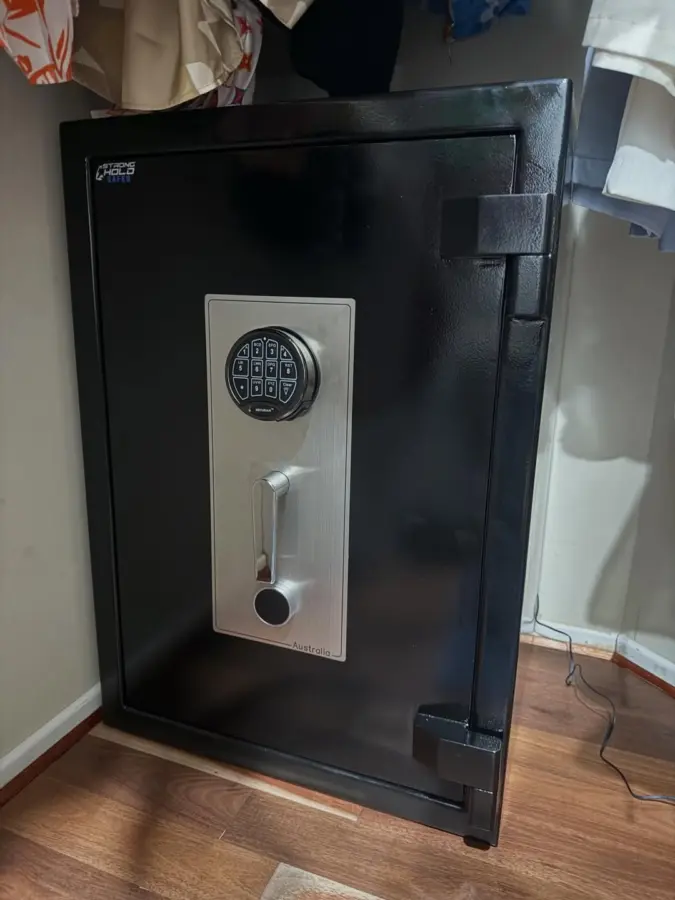
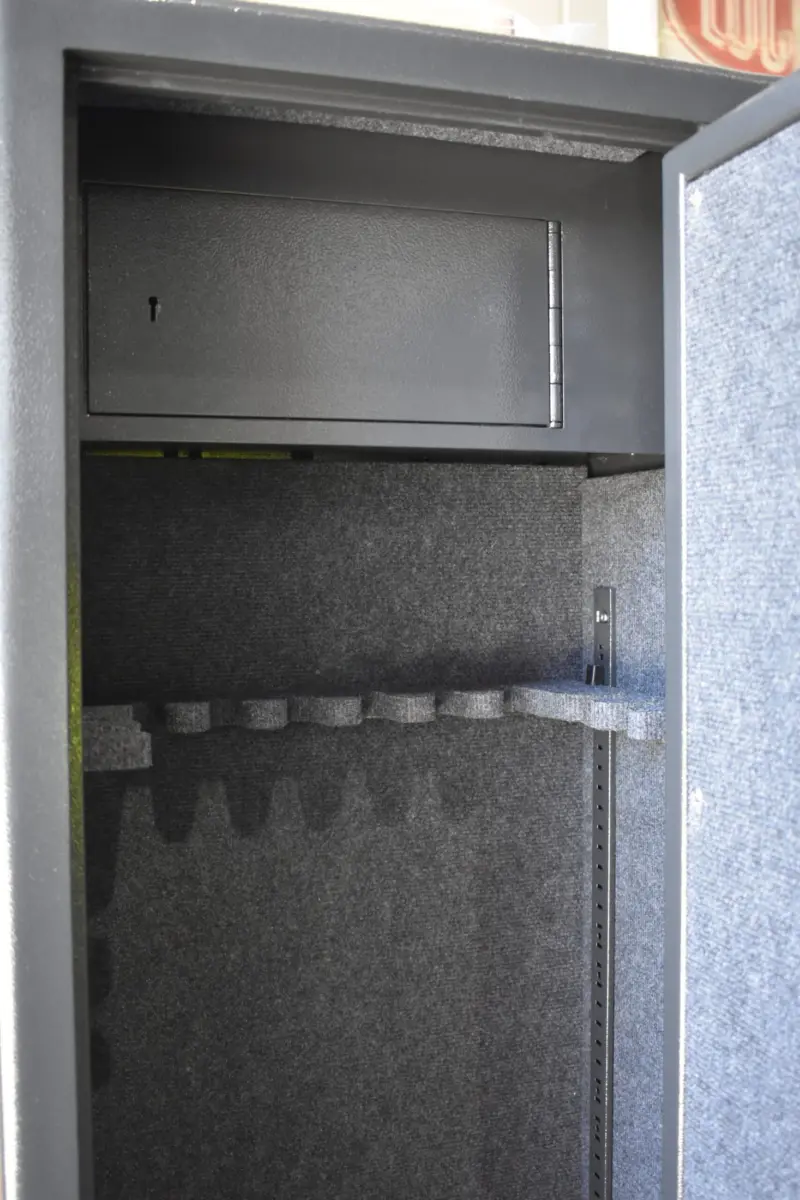
Stronghold’s RS10 rifle safe has a 180 kg steel body, a 6 mm steel door, 30 mm three-way boltwork, 30 minutes of fire resistance and an internal lockable cupboard for ammunition, with four 16 mm recessed holes for floor mounting and a choice of digital (with key override), key or dial-combination locks; setup guides are on our lock instructions page. Whether it suits you depends on your jurisdiction, category and number of firearms, so check with us and your registry before you buy. We recommend bolting it down even though it weighs more than 150 kg.
Checklist
- Confirm your categories and number of firearms.
- Keep a copy of your regulator’s current requirements.
- Check steel thickness, locks, hinges and weight against those requirements.
- Plan how and where the safe will be bolted.
- Store ammunition in a separate locked container or compartment.
- Recheck the rules whenever you add firearms or move house.
Frequently asked questions
Does a safe over 150 kg need to be bolted down?
In several jurisdictions the bolting rule applies only below 150 kg for Category A and B, but NSW requires Category C, D and H safes to be bolted to the structure, and other states have similar rules. Bolting is good practice whatever the weight.
Can ammunition go in the same safe?
Often, if it is in a separately locked compartment. Victoria accepts purpose-built units with two lockable compartments, while Tasmania requires a compartment not opened by the same key. Check your state’s wording.
How often do the rules change?
Often. NSW, Queensland and Western Australia have all changed requirements since 2025, so recheck before buying or renewing.
For help choosing compliant storage, speak with a Stronghold specialist or visit a showroom. Bring your registry’s requirements and we will talk you through the options and arrange professional installation.